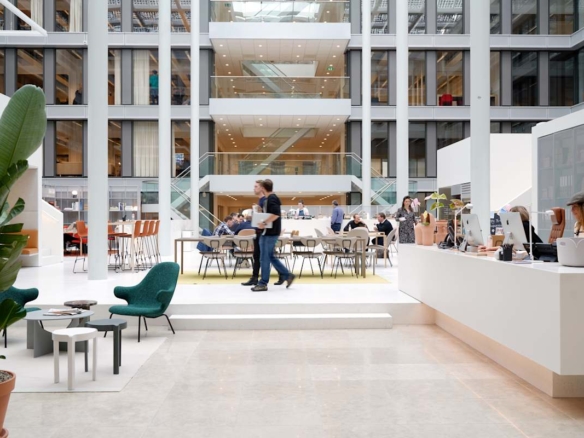
Office space in Charlotte

Charlotte’s office market spans Uptown’s Class A towers and corporate headquarters through South End’s transit-oriented developments, positioned as the second-largest financial centre in the United States anchored by Bank of America and Wells Fargo headquarters. The workspace landscape reflects rapid growth across technology, healthcare, energy, and advanced manufacturing alongside financial operations.
Featured

Office spaces in Charlotte

A selection of the best workspaces in Charlotte

No listing found.

No listing found.

Featured

Office spaces in Charlotte

A selection of the best workspaces in Charlotte

Trusted by leading companies

Looking for workspace in Charlotte?

Our advisory team searches the full market on your behalf. Cost-free service for flexible workspace searches. Shortlist within 24 hours.

market overview

America's second banking capital

Charlotte serves as the second-largest financial centre in the United States after New York, anchoring a regional economy driven by banking, financial services, professional services, and technology. Bank of America maintains its global headquarters here, whilst Wells Fargo operates a major regional centre. Beyond banking, the economy spans technology, healthcare, energy, and advanced manufacturing sectors serving regional and national markets. The Charlotte region accounts for a fifth of North Carolina’s economic output, with population approaching three million.

Office space concentrates across distinct districts reflecting different market segments. Uptown forms the central business district, home to Class A towers and corporate headquarters. South End has evolved into a transit-oriented development zone, blending converted warehouses with new builds along the light rail corridor, attracting tech firms and creative businesses. The region’s growth has expanded office opportunities across multiple neighbourhoods, allowing companies to position themselves near specialised talent or industry clusters.

Transport infrastructure and economic scale strengthen Charlotte’s competitive position. Charlotte Douglas International Airport serves major North American and intercontinental routes. High-speed rail development continues advancing regional connectivity. The city’s concentration of financial institutions, growing tech ecosystem, and geographic position in the Southeast establish Charlotte as the strategic location for companies requiring financial sector access or southeastern US market coverage.

Key Industries

What type of companies are based in Charlotte?

Banking

Financial Services

Energy

Professional Services

Real Estate

Logistics and Supply Chain

Your questions answered

Common questions

Uptown Charlotte, the city’s CBD, anchors banking, law firms, professional services and corporate occupiers, with deep Grade A supply near the Bank of America and Duke Energy towers and the Charlotte Gateway Station corridor. SouthPark is the primary suburban business node, hosting investment management, law firms and consumer finance. South End, south of the CBD along the light rail corridor, draws tech, creative and startup occupiers in converted industrial stock. Ballantyne in the south serves larger back-office operations and corporate campuses. University City hosts tech and R&D firms near UNC Charlotte.
Charlotte is the second-largest banking centre in the United States by assets, anchored by Bank of America and a major Wells Fargo presence, alongside Truist and regional financial services firms. The flex market reflects this, with strong demand from banks, fintech, law firms and professional services, and growing tech and energy occupiers. Supply is concentrated in Uptown and extending into South End and SouthPark, with national coworking operators and local providers both present. The market leans toward private offices and team suites rather than hot-desk-dominated coworking.
Charlotte is the strongest US financial services base outside New York, widely used for banking operations, capital markets support, fintech development and professional services serving the banking sector. Bank of America’s global headquarters, a major Wells Fargo presence, Truist and a dense supplier ecosystem make it practical for banks, fintech scale-ups and specialist advisers to locate here. Flex supply in Uptown and South End is well-matched to financial services needs, with enterprise-grade IT, secure meeting suites and bank-adjacent building choices. Lower costs than New York and a strong talent pool support long-term scaling.
Charlotte offers a substantial flexible workspace market dominated by serviced offices, with supply concentrated across Uptown Charlotte, SouthPark, South End and the Ballantyne corridor. Operators range from global brands to boutique providers serving banking, financial services and a fast-growing tech and fintech base. Coworking is more limited but present, with operators concentrated across South End and Uptown, supporting founders, scale-ups and creative agencies. Managed offices, where space is fitted bespoke for a single tenant on a flex contract, are not yet a meaningful part of the Charlotte market.
Flexible workspace demand in Charlotte is overwhelmingly anchored by financial services, with Bank of America’s global headquarters, Truist, Wells Fargo’s East Coast operations, Ally Financial and a deep cluster of asset managers, insurers and fintech firms driving the bulk of activity across Uptown and SouthPark. Energy occupiers, anchored by Duke Energy and Honeywell, maintain large flex footprints. Technology, fintech and insurtech are the fastest-growing sectors, supported by a strong venture-backed startup community across South End. Professional services, law firms, manufacturing HQs (Lowe’s, Sonic Automotive) and a substantial logistics base round out demand.