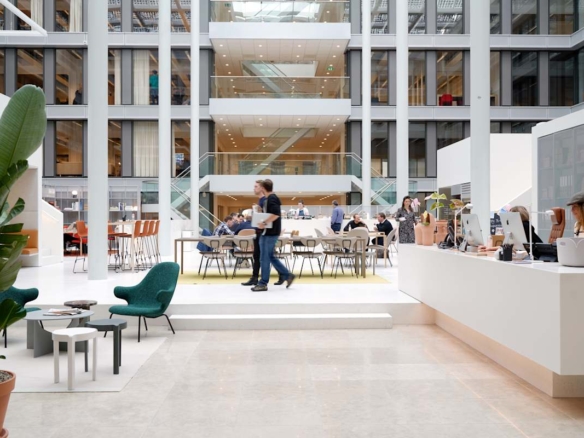
Office space in Chicago

Chicago’s office market spans the traditional Loop through emerging tech and creative districts in the West Loop, River North, and Fulton Market, serving over 30 Fortune 500 headquarters anchored by deep expertise in finance, technology, and healthcare research. The workspace landscape reflects a diversified economy with sustained demand across sectors.
Featured

Office spaces in Chicago

A selection of the best workspaces in Chicago

No listing found.

No listing found.

Featured

Office spaces in Chicago

A selection of the best workspaces in Chicago

Trusted by leading companies

Looking for workspace in Chicago?

Our advisory team searches the full market on your behalf. Cost-free service for flexible workspace searches. Shortlist within 24 hours.

market overview

Midwest command centre for finance and innovation

Chicago anchors the Midwest economy with a GDP exceeding $1 trillion and a workforce spanning finance, technology, life sciences, and advanced manufacturing. The city hosts over 30 Fortune 500 headquarters and maintains recognised expertise in fintech, food innovation, and healthcare research, serving companies from established corporates to venture-backed startups. Financial services remain core, with deep capability in banking, commodities trading, and insurance operations supporting regional and national enterprises.

The office market reflects Chicago’s distinct neighbourhood specialisms. The Loop remains the traditional Central Business District, anchoring banking, legal, and insurance firms around LaSalle Street’s trading operations. The West Loop has emerged as the leading tech and creative district, attracting startups and established companies seeking modern workspace. River North and Fulton Market continue drawing media, advertising, and design businesses. This geographic dispersion allows companies to position themselves within sectors or talent pools rather than defaulting to a single core.

Transport connectivity and talent availability strengthen Chicago’s competitive position. O’Hare and Midway airports provide direct access to major North American and international hubs. The city’s universities supply a skilled workforce, whilst its central location serves companies operating across the continent. This combination positions Chicago as the strategic base for companies requiring Midwest market access and substantial operating scale.

Key Industries

What type of companies are based in Chicago?

Financial Services

Manufacturing

Professional Services

Logistics and Supply Chain

Healthcare

Technology

Your questions answered

Common questions

The Loop, Chicago’s historic CBD, anchors banking, law firms, exchange-adjacent trading, professional services and corporate occupiers, with deep supply in Grade A towers along Wacker Drive, LaSalle Street and Madison. River North draws advertising, creative agencies, tech and media firms. Fulton Market has emerged as a major tech and consumer brand cluster around Google’s Chicago hub. The West Loop, extending through Union Station, suits consulting, asset management and corporate HQs. Streeterville and the Gold Coast serve boutique professional services and firms close to the Magnificent Mile.
Chicago is the largest commercial centre in the US Midwest, with a flex market driven by finance, particularly CME and CBOE-adjacent trading, banking, law, consulting, advertising, consumer goods and a growing tech scene anchored by Google’s Fulton Market campus. Supply is deep across the Loop, River North, Fulton Market and the West Loop, with major national coworking operators and strong local providers competing. The market leans toward private offices and team suites, with significant managed office demand from corporates diversifying beyond traditional leases.
Chicago O’Hare is one of the busiest airports in the world, with near-universal non-stop coverage of US cities and extensive international routes to Europe, Asia and Latin America, making the city exceptionally practical for multi-city client coverage. Midway adds substantial domestic capacity and lower-cost routes. The CTA L rail, Metra commuter rail and Amtrak’s Union Station support strong regional and cross-city connectivity. Amtrak services also reach Milwaukee, St Louis and Detroit in a few hours, and most flex buildings in the Loop and River North sit within a short walk of a station.
Chicago offers a deep flexible workspace market dominated by serviced offices, with supply concentrated across the Loop, the West Loop, Fulton Market, River North, Streeterville and the wider Magnificent Mile corridor. Operators range from global brands to boutique providers serving Fortune 500 corporate HQs, financial services, law firms and a fast-growing tech and consumer goods base. Coworking is well represented, particularly across Fulton Market, River North and the West Loop, supporting founders, scale-ups and creative agencies. Managed offices, where space is fitted bespoke for a single tenant on a flex contract, are not yet a meaningful part of the Chicago market.
Flexible workspace demand in Chicago is shaped by an exceptionally broad Fortune 500 base. Financial services, including the CME Group, Northern Trust, Citadel, Discover Financial and a deep insurance and asset management community, anchor the Loop and West Loop. Professional services, law firms and consulting concentrate across the central business districts, with major presences from McDonald’s, Boeing’s historic operations, United Airlines and Walgreens Boots Alliance. Manufacturing and industrial HQs (Caterpillar, Abbott Laboratories, Mondelez) support strong supplier networks. Technology and fintech cluster around Fulton Market and River North, with Google’s Midwest HQ and a vibrant startup community.