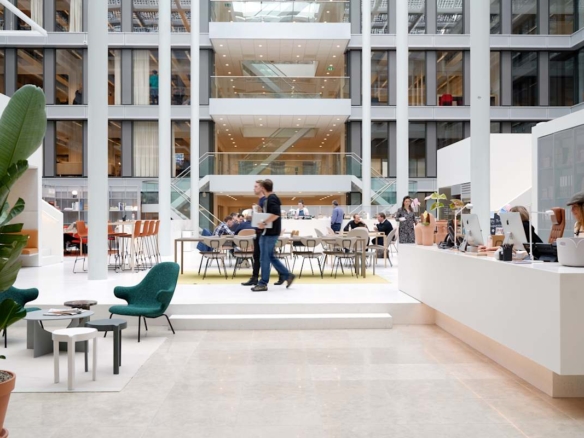
Office space in Mexico City

Latin America’s largest office market supports a maturing multi-district workspace ecosystem spanning established financial cores in Polanco, Santa Fe and Reforma, alongside creative and tech-focused hubs in Roma and Condesa. The market ranges from Grade A corporate towers to flexible coworking in emerging neighbourhoods like Juárez and Anzures.
Featured

Office spaces in Mexico City

A selection of the best workspaces in Mexico City

No listing found.

No listing found.

Featured

Office spaces in Mexico City

A selection of the best workspaces in Mexico City

Trusted by leading companies

Looking for workspace in Mexico City?

Our advisory team searches the full market on your behalf. Cost-free service for flexible workspace searches. Shortlist within 24 hours.

market overview

Latin America's commercial centre

Mexico City dominates Latin America’s commercial landscape as the region’s largest economy and political capital. The city’s office market reflects its broad economic base across finance, multinational manufacturing, technology, and creative industries, supported by a metropolitan population exceeding 21 million. Financial services, banking, and corporate headquarters concentrate in Polanco and Santa Fe, the latter emerging as the city’s largest modern corporate zone with contemporary high-rise developments, parking infrastructure, and dedicated amenity provision. Multinational corporations and regional tech operations balance costs against the city’s size and market access.

The workspace offer spans established districts with distinct profiles. Reforma maintains historic commercial prestige alongside new construction. Santa Fe attracts institutional capital and banking operations drawn by modern infrastructure. Polanco serves luxury professional services and corporate offices. Roma and Condesa have repositioned as bases for startups and design-led businesses, offering refurbished period buildings and flexible layouts at lower rents than prime locations.

Transport connectivity to Benito Juárez International Airport positions the city as a gateway for regional operations. The city supports a deep talent base drawn from leading universities and growing venture capital activity, which has accelerated startup formation across technology, fintech, and digital services sectors. Office costs remain competitive relative to North American equivalents, positioning Mexico City as a practical alternative for companies seeking Latin American regional presence.

Key Industries

What type of companies are based in Mexico City?

Financial Services

Manufacturing

Media

Professional Services

Telecommunications

Real Estate

Your questions answered

Common questions

Polanco remains the premium cluster, with Torre Virreyes, Torre Manacar and the Miyana complex housing banking, private equity and multinational consumer tenants. Reforma between the Angel de la Independencia and the Auditorio is dominated by grade A towers including Torre BBVA, Torre Reforma and Chapultepec Uno, home to banking, energy and legal tenants. Santa Fe is the purpose-built corporate cluster on the western edge, used by GCC-style shared services for banks and pharma. Condesa and Roma Norte attract creative, media and scaling tech firms in converted stock. Interlomas and the Corredor Perisur serve domestic corporates and family offices.
Mexico City is the commercial capital of Latin America’s second-largest economy and the main hub for nearshoring activity as US firms relocate manufacturing and services closer to home. The occupier mix spans banking, telecoms, energy, consumer goods, pharma and a deep fintech and startup ecosystem anchored by Kavak, Clip and Konfio. Flex supply has expanded rapidly, with WeWork, Regus, IOS Offices, Spaces and domestic brand PUBLICO active across Polanco, Reforma and Santa Fe. Nearshoring-driven US tenants increasingly take multi-month managed offices as they set up entities, making private suites the dominant product.
Mexico City sits at around 2,240 metres above sea level, and air quality during winter thermal inversions can be poor, so MERV 13 or equivalent filtration and efficient HVAC are commonly specified in premium buildings. Commute times are notoriously long, with Santa Fe particularly prone to congestion along the Constituyentes and Tamaulipas corridors, so occupiers often match workspace to where their senior staff live in Polanco, Las Lomas and Condesa. Metrobus Line 7 along Reforma and the expanded Line 12 of the Metro have made central locations more attractive, and buildings near Auditorio, Chapultepec and Sevilla stations typically shortlist well.
Mexico City offers a deep flexible workspace market dominated by serviced offices, with supply concentrated across Polanco, Reforma, Santa Fe, Insurgentes Sur and Lomas. Operators range from global brands to long-established Latin American platforms, supporting banking, manufacturing HQs, multinational regional teams and trading occupiers covering Mexico and Central America. Coworking is well represented, particularly across Polanco, Roma Norte and Condesa, supporting founders, design studios, creative agencies and a substantial digital nomad community. Managed offices, where space is fitted bespoke for a single tenant on a flex contract, are not yet a meaningful part of the Mexico City market.
Flexible workspace demand in Mexico City is anchored by financial services, with BBVA Mexico, Citibanamex, Banorte, Santander Mexico and a deep cluster of asset managers and insurers concentrated across Reforma and Santa Fe. Manufacturing HQs across automotive, consumer goods, food and beverage and aerospace maintain large supplier networks. Multinational regional HQs covering Latin America cluster across Polanco and Santa Fe. Energy, anchored by Pemex and a wide range of midstream and renewables firms, drives substantial demand. Technology, fintech and e-commerce are growing rapidly, supported by Kavak, Clip and a strong venture-backed startup community. Telecoms, professional services and media round out demand.