Office space in Southampton

Southampton’s office market serves a maritime-driven economy with space concentrated across a regenerated city centre, waterfront, and science park clusters. The deep-water port anchors logistics and shipping demand, while the university supports innovation sectors and research-led occupiers.
Featured

Office spaces in Southampton

A selection of the best workspaces in Southampton
Featured

Office spaces in Southampton

A selection of the best workspaces in Southampton

Trusted by leading companies

Looking for workspace in Southampton?

Our advisory team searches the full market on your behalf. Cost-free service for flexible workspace searches. Shortlist within 24 hours.

market overview

Port city with maritime logistics and science park specialisms

Southampton’s economy depends on its deep-water port, which drives significant maritime, logistics, and cruise operations activity alongside financial services and creative industries. The University of Southampton anchors innovation in engineering, health sciences, and technology, supporting demand from research-driven businesses and professional services firms.

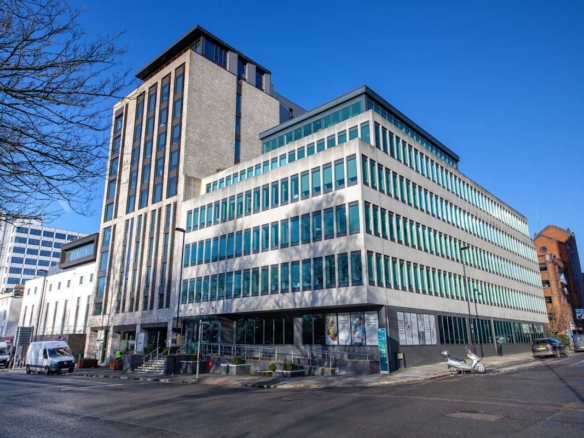
Office space concentrates across three main territories: the city centre offers refurbished period buildings and modern stock positioned near retail and transport hubs; Ocean Village and the waterfront have attracted professional services and technology firms to contemporary environments with waterfront positioning; Southampton Science Park provides purpose-built facilities linked to university research output and innovation activities. Business parks along the M27 corridor serve logistics and operational functions with freeway access.

The city’s strategic position offers coastal access combined with London connectivity via the M3 motorway and direct rail services, making Southampton a natural base for companies balancing capital proximity with port operations. Transport infrastructure includes container and cruise terminals, motorway access, and Southampton Airport serving regional and European markets. The skilled workforce reflects both maritime engineering heritage and university-driven technical disciplines, supporting occupiers across marine engineering, logistics, technology, and professional services sectors.

Key Industries

What type of companies are based in Southampton?

Maritime Services

Logistics and Supply Chain

Education

Tourism and Hospitality

Manufacturing

Your questions answered

Common questions

Ocean Village and the Itchen Waterfront attract professional services, marine and shipping-linked firms in converted and new-build waterfront stock. The city centre around Above Bar Street and the Civic Centre holds legal, accountancy and insurance tenants. Westquay area and the Southampton West Quay retail-led district serve mid-market corporate tenants. Chilworth Science Park near the University of Southampton anchors tech, engineering and research-linked firms. Nursling and Adanac Park on the western edge host larger corporate campuses including Ordnance Survey’s headquarters. Portswood and the University quarter host smaller spinouts and scaleups. Whiteley and the Solent Business Park serve suburban corporate and back-office operations.
Southampton is the largest city on England’s south coast and a major centre for maritime, cruise, marine engineering, legal services, insurance and technology linked to the University of Southampton. Ocean-going cruise operations at the Port of Southampton, Carnival UK’s headquarters and a deep marine industry anchor specialist occupier demand. Flex supply is modest, with Regus, Basepoint, City Space and Workspace Group locations spread between the centre and Ocean Village. Rents are significantly below London, Reading and Bristol, which has attracted satellite offices from firms along the M3 and M27 corridors and supported professional services growth linked to the university’s research and engineering activity.
The University of Southampton is a Russell Group research institution with particular strengths in electronics, photonics, ocean sciences and AI, anchoring a sustained spinout and industrial partnership pipeline. This drives demand for flex space at Chilworth Science Park and the Southampton Science Park, often from small scaleups needing room to grow into larger private suites within the same location. The university’s partnership with Lloyd’s Register, Ordnance Survey and large engineering firms supports a steady stream of collaborative research space requirements, which tends to favour buildings offering both flexible office and lab-enabled options rather than purely coworking.
Southampton offers a complete flexible workspace stack across the city. Serviced offices anchor supply across the city centre around Above Bar Street and Cumberland Place, the Ocean Village waterfront and the wider M27 business corridor at Solent Business Park and Whiteley. Coworking is more limited but present, with operators across the city centre and Ocean Village, suiting founders, design studios and tech scale-ups. Managed offices, where space is fitted bespoke for a single tenant on a flex contract, are also offered across modern Class A buildings such as 50 Holyrood for occupiers wanting a tailored environment without a conventional lease.
Flexible workspace demand in Southampton is anchored by maritime and shipping, given the Port of Southampton’s role as the UK’s largest cruise port and a major container terminal. Carnival UK, P&O Cruises, Cunard and a deep cluster of shipping, port and marine engineering firms drive substantial occupancy. Aerospace and defence, anchored by GE Aviation Systems, BAE Systems and the wider Southampton-Solent cluster, drive further demand. Financial services and insurance, with Aviva, B&Q’s parent Kingfisher and a strong professional services community, anchor the city centre. The University of Southampton’s research output, healthcare, marine science and a growing tech and games scene round out demand.