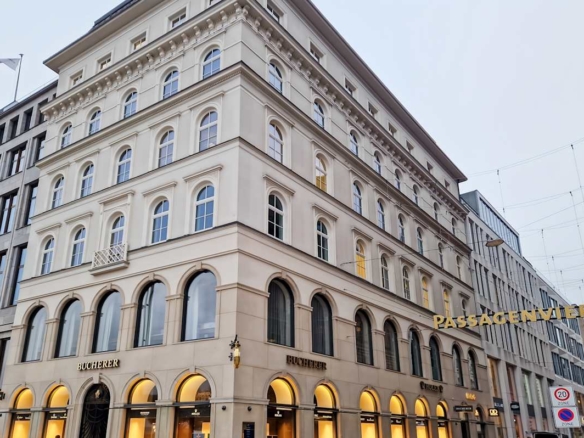
Office space in Hamburg

Hamburg’s office market spans the traditional Altstadt and Neustadt commercial core, HafenCity’s major urban regeneration project, and surrounding districts, supporting a diverse economy anchored by maritime, logistics, media, and growing technology sectors.
Featured

Office spaces in Hamburg

A selection of the best workspaces in Hamburg

No listing found.

No listing found.

Featured

Office spaces in Hamburg

A selection of the best workspaces in Hamburg

Trusted by leading companies

Looking for workspace in Hamburg?

Our advisory team searches the full market on your behalf. Cost-free service for flexible workspace searches. Shortlist within 24 hours.

market overview

Northern Europe's maritime and tech centre

Hamburg functions as Germany’s second-largest city and a major economic centre for northern Europe. The city’s economy is anchored by maritime industries, logistics, aviation, and renewable energy sectors, complemented by strong media, life sciences, and technology presence. These diverse economic strengths are reflected in consistent office demand: net take-up reached 308,000 square metres across the first three quarters of 2025, with prime rents stabilised at 36 euros per square metre and average rents at 22.50 euros per square metre. Vacancy rates stand at 6 per cent, with modern Grade A space accounting for 27 per cent of available stock.

Office space concentrates across several districts. The Altstadt and Neustadt form the commercial core, housing corporate headquarters and financial services operations. HafenCity represents one of Europe’s largest urban regeneration projects, adding contemporary office stock, residential development, and cultural facilities to the city’s waterfront. The district has attracted multinational companies, tech startups, and media operations seeking modern specification space positioned within a wider mixed-use urban environment.

The city is home to Germany’s largest port and serves as a critical gateway for international trade across northern Europe. Direct air connections to London, Paris, Amsterdam, and beyond support the city’s role as a business centre. Hamburg attracts logistics firms, media companies, and tech startups requiring flexible workspace to scale quickly without long-term commitments. The market includes established global operators alongside local providers offering tailored solutions for small and mid-sized enterprises and corporate teams.

Key Industries

What type of companies are based in Hamburg?

Logistics and Supply Chain

Media

Manufacturing

Aerospace

Tourism and Hospitality

Financial Services

Your questions answered

Common questions

The city centre around Neuer Wall, Jungfernstieg and Rathausmarkt holds the prime professional services, legal and banking stock, with premium serviced office operators in refurbished Hanseatic buildings. HafenCity is the largest new-build cluster, attracting media, consulting and shipping tenants in towers such as the Intelligent Quarters and the Elbarkaden. St Pauli and the Schanzenviertel suit creative agencies, tech and design studios. Altona and Ottensen offer scaling media and publisher occupiers, and the City Nord business park north of the Stadtpark remains important for energy, insurance and older corporate tenants.
Hamburg is Germany’s second-largest city and its largest port, with a diverse economy spanning logistics, shipping, media, aviation, consumer goods and a growing digital and renewable energy base. The city has one of the largest publisher and broadcaster clusters in Europe, anchoring a creative occupier pool that sits alongside traditional Hanseatic trading houses. Flex demand is balanced between corporate managed suites in HafenCity and city centre and smaller creative floors in the Schanzenviertel. Stock quality is high, with strict planning and design standards in HafenCity giving the area a consistent, ESG-aligned delivery profile.
HafenCity is one of Europe’s largest inner-city regeneration projects, with strict HafenCity Hamburg GmbH design guidelines that push for higher energy performance, active ground floors and mixed-use blocks. The result is consistently modern, well-specified offices with good floorplates and waterfront views, but at a premium to traditional Altstadt stock. Occupiers with ESG reporting requirements or large-floorplate needs often shortlist HafenCity first. Smaller tenants and those wanting denser street life and transport options sometimes prefer the Altstadt around Jungfernstieg or the livelier Schanzenviertel, where redevelopment is less tightly controlled.
Hamburg offers a deep flexible workspace market dominated by serviced offices, with supply concentrated across the Innenstadt around the Alster, the HafenCity waterfront regeneration, the Speicherstadt and the Eimsbuttel and Altona corridors. Operators range from global brands to long-established German platforms, supporting media, shipping, professional services and corporate occupiers. Coworking is well represented, particularly across HafenCity, the Speicherstadt and Altona, supporting tech scale-ups, design agencies and creative firms. Managed offices, where space is fitted bespoke for a single tenant on a flex contract, are not yet a meaningful part of the Hamburg market.
Flexible workspace demand in Hamburg is anchored by media and publishing, with Bauer Media, Spiegel, Gruner + Jahr (now part of RTL Deutschland) and a deep cluster of advertising and creative agencies driving substantial occupancy. Shipping and logistics, anchored by the Port of Hamburg, Hapag-Lloyd, Beiersdorf and a wide range of trading firms, maintain large flex footprints. Aerospace, with Airbus’s commercial aircraft assembly at Finkenwerder, drives substantial supplier demand. Renewables, particularly offshore wind, are growing rapidly. Professional services, banking, e-commerce (Otto Group), and a substantial gaming and music industries cluster round out demand.